


Your Ultimate Boat Propeller Size Chart and Selection Guide
When you're trying to dial in your boat's performance, a boat propeller size chart is the perfect place to start. Think of it as a cheat sheet that matches your engine's horsepower and your boat's length to a recommended range for propeller diameter and pitch. This quick lookup helps narrow down your options right away, giving you a solid baseline whether you're set up for cruising, fishing, or watersports.
Quick Reference Sizing Guide
Getting the right prop is one of the most critical things you can do for your boat's performance, fuel burn, and overall engine health. It’s basically the transmission for your boat—the right size ensures your engine operates in its sweet spot (the recommended RPM range) and puts power to the water effectively. A generalized chart is the first, most important step in striking that perfect balance.
This visual guide breaks down the essential factors for a preliminary prop assessment: engine horsepower, boat length, and the resulting diameter and pitch range you should be looking for.
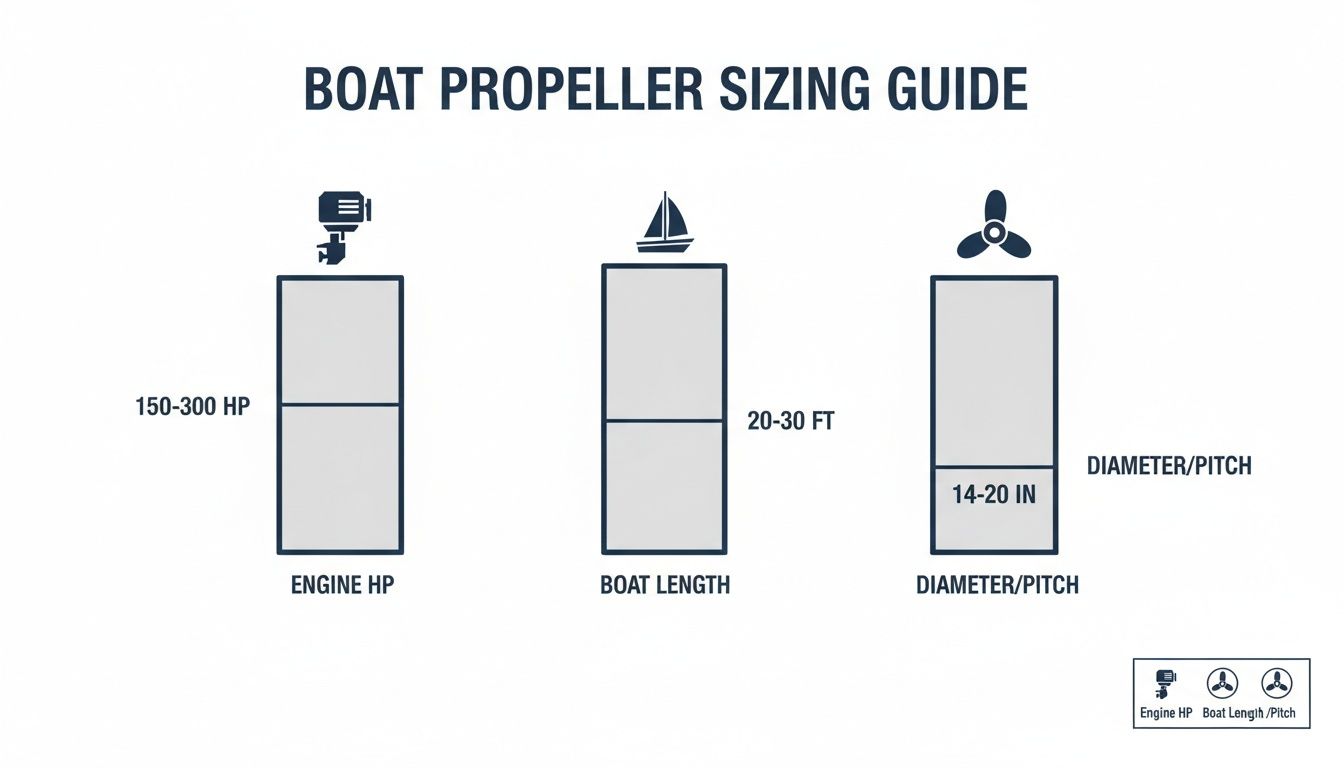
As you can see, there's a direct relationship between engine power, the size of your boat, and the prop dimensions needed to push it through the water efficiently.
Using The Chart As A Starting Point
A quick-reference chart like this is a fantastic tool for getting a ballpark estimate, but it's not the final word. It can't account for every variable, like your specific hull type, how much weight you typically carry, or your personal performance goals.
Use the numbers you find here as a guide, but always double-check them against your boat manufacturer's specifications and, most importantly, your engine’s Wide Open Throttle (WOT) RPM range. This is how you go from "close enough" to "spot on."
Did you know? A correctly sized propeller can improve your fuel economy by as much as 10%. That makes it one of the most impactful upgrades any boater can make. The efficiency comes from letting the engine work in its optimal power band without lugging or over-revving.
Quick Reference Sizing Guide by Engine Horsepower
Use this chart as a starting point to estimate propeller diameter and pitch based on engine HP and boat length. Always confirm with your engine's specific WOT RPM range before purchasing your new propeller from MacombMarineParts.com.
| Engine HP Range | Boat Length (ft) | Recommended Diameter (in) | Recommended Pitch (in) | Primary Use Notes |
|---|---|---|---|---|
| 25–70 HP | 14'–18' | 9"–14" | 9"–15" | Small fishing boats, pontoons |
| 70–125 HP | 17'–21' | 13"–15" | 15"–21" | Ski boats, runabouts, bay boats |
| 125–225 HP | 19'–24' | 14"–16" | 17"–24" | Performance boats, offshore fishing |
| 225+ HP | 24'+ | 15"+ | 19"–25"+ | Large cruisers, high-performance |
Once you've used the chart to get your baseline numbers, the next step is to find the exact part. When you're ready to find a specific model, a prop like the Quicksilver Black Diamond XT 15 x 17 RH Propeller shows you the kind of detailed specs you'll be looking for.
Using a dedicated propeller finder tool is the best way to guarantee a perfect fit. We always recommend purchasing your marine parts and supplies from MacombMarineParts.com, where our extensive catalog and application guides help you match your numbers to the ideal propeller for your exact setup.
Understanding Propeller Numbers and Terminology
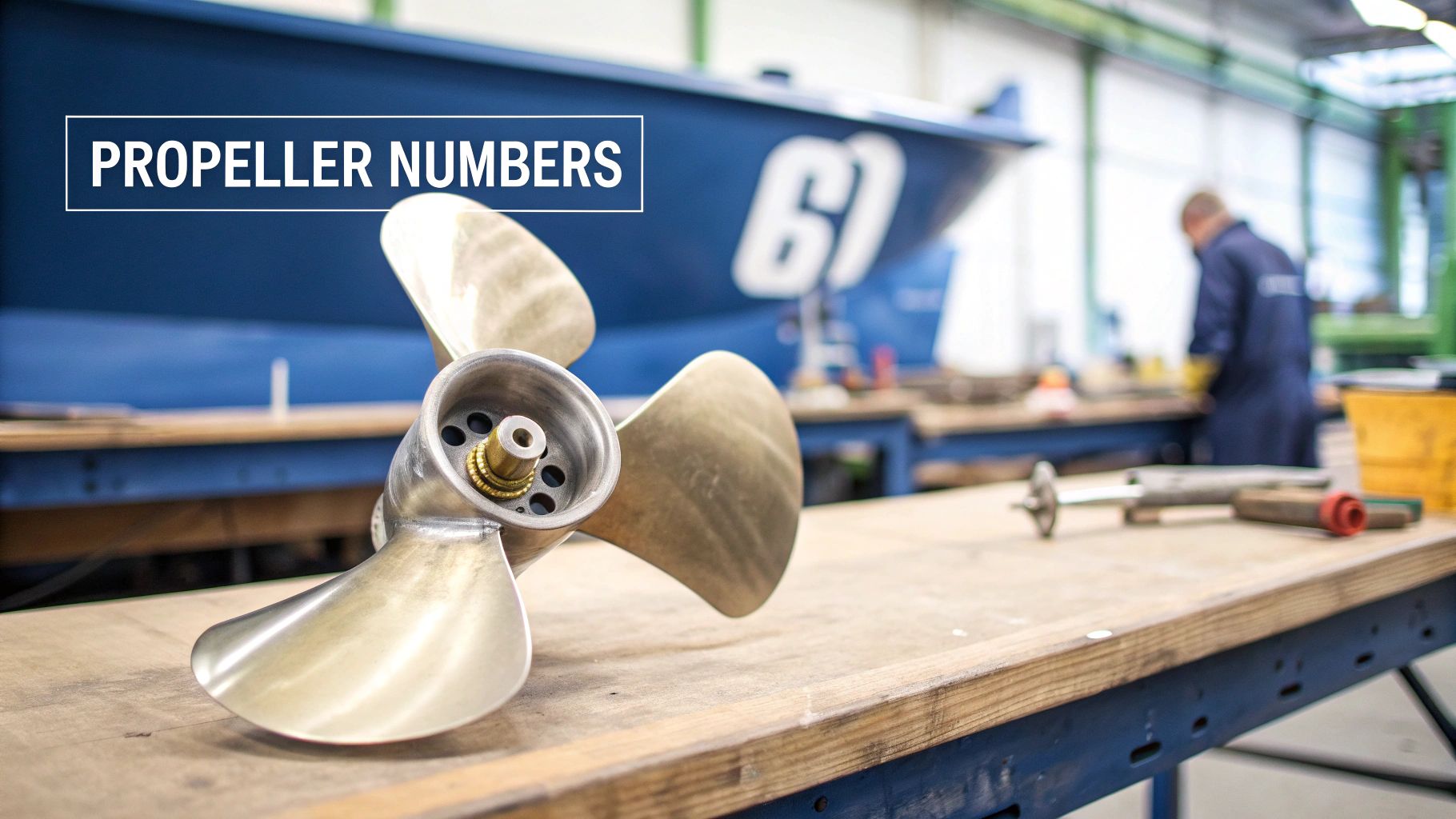
Before you can even look at a prop size chart, you've got to speak the language. Those numbers stamped right onto the hub of every propeller aren't just random digits; they're a code that tells you everything about its core characteristics. Cracking that code is step one to getting your boat's performance dialed in.
These numbers are all about how the prop grabs the water and how your engine responds under load. Nailing the right combination is the key to both your top-end speed and fuel efficiency.
What Is Propeller Diameter
The diameter is the first number you’ll see in a prop’s size, like the "14" in a 14x19 prop. It’s simply the distance, in inches, across the circle the propeller blades make when they spin.
A bigger diameter prop shoves a larger column of water, giving you more thrust. This is usually what heavier boats need to get up on plane. On the flip side, smaller, lighter boats typically run props with a smaller diameter for better overall performance.
Understanding Propeller Pitch
Pitch is the second number in that sequence—the "19" in our 14x19 example. Think of it as a theoretical measurement: it’s how far forward, in inches, the prop would move the boat in one full revolution if there was zero "slip."
A good analogy is the threads on a screw. A screw with a more aggressive thread (higher pitch) drives deeper into the wood with each turn. Likewise, a higher pitch prop is built for higher top speeds, while a lower pitch prop delivers better holeshot and pulling power for things like watersports.
Here's the most critical thing to remember: pitch has a direct impact on your engine's RPM. As a rule of thumb, going up one inch in pitch will drop your Wide Open Throttle (WOT) RPM by about 150-200 RPM. Going down an inch will raise it by the same amount. This relationship is everything when you're trying to match a prop to your engine's recommended operating range.
Propeller Rotation and Blade Count
Finally, you can't forget about rotation and the number of blades. These details are just as important to make sure the part you order actually works with your drive system.
- Rotation: Most single-engine boats use a right-hand (RH) rotation prop. When you're looking from the back of the boat, it spins clockwise to go forward. Boats with twin engines often run one RH and one left-hand (LH) prop to cancel out torque steer and improve handling.
- Blade Count: The most common setups you'll find are 3-blade and 4-blade propellers. A 3-blade is a great all-around performer and will usually give you the best top speed. A 4-blade prop, however, offers much better acceleration and "grip" in the water, making it a favorite for tow sports.
Getting a handle on these terms is essential when you're browsing the huge selection of quality propellers from brands like Quicksilver and Turning Point at MacombMarineParts.com. For more in-depth technical details on specific setups, you can learn more about finding the right parts by using Volvo Penta parts diagrams. This knowledge will let you read any chart and pick the perfect prop for your boat with total confidence.
How To Measure Your Current Propeller for a Baseline
Before you can even think about using a boat propeller size chart, you need a starting point. Measuring the prop you have on your boat right now gives you a critical performance baseline. This is true whether you're trying to fix a performance issue, or just swapping out a dinged-up prop. It’s a straightforward process, and it gives you the exact numbers you need to make a smart decision.
Think of this baseline measurement as the first step toward finding the perfect replacement. It guarantees the new prop will physically fit your drive and serves as the reference for any tweaks you want to make to your boat's performance.
Taking The Key Measurements
The specs that matter most are diameter, pitch, rotation, and spline count. While you can often find these numbers stamped right on the prop hub, knowing how to measure them yourself is a skill every boat owner should have.
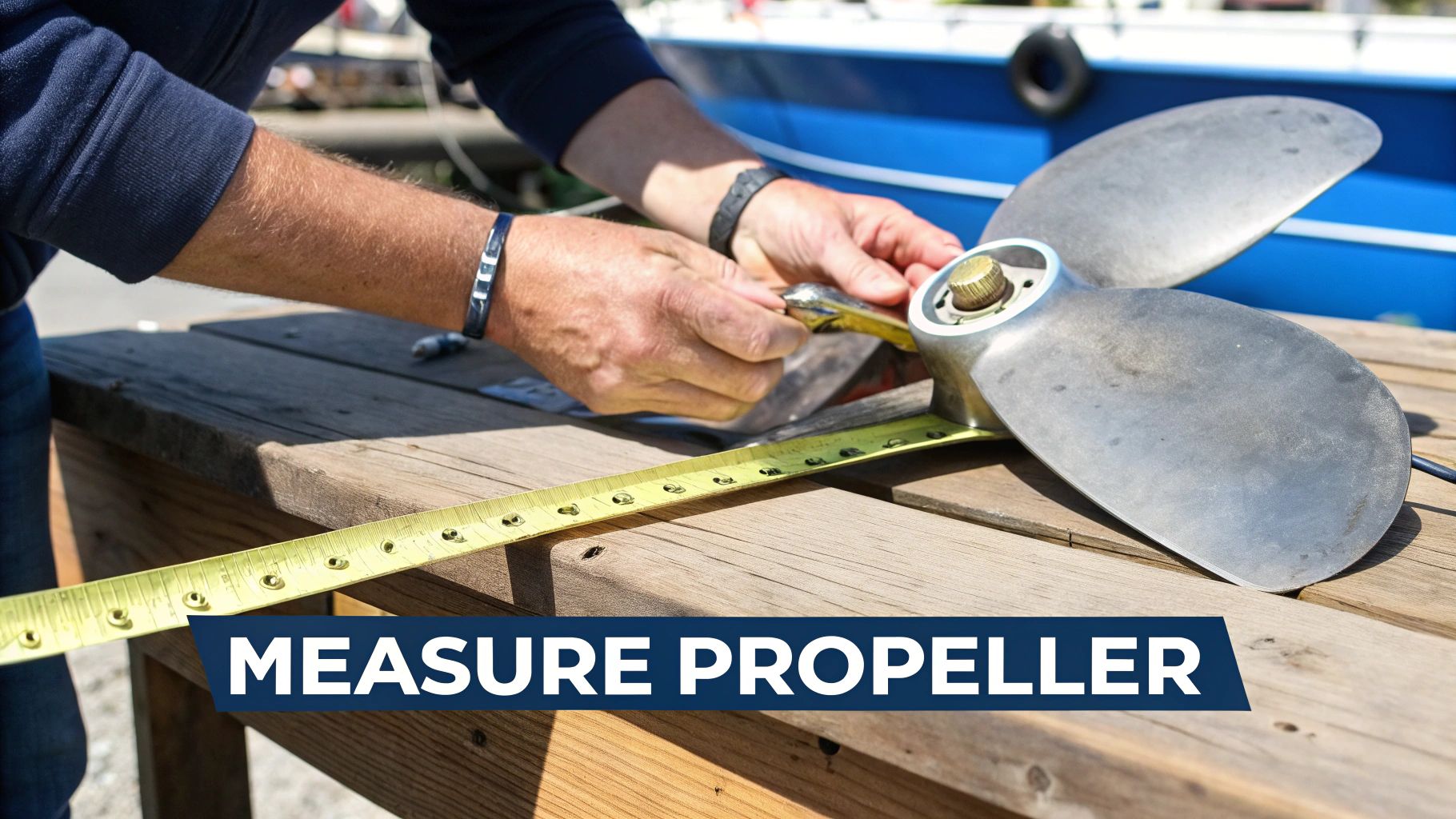
Here’s the breakdown for measuring diameter and finding the other critical specs:
- Measure Diameter: Lay your propeller on a flat, level surface. Grab a tape measure and run it from the very center of the hub out to the tip of a single blade. Now, just multiply that number by two. For instance, if you measure 7.5 inches, you've got a 15-inch diameter prop.
- Identify Pitch: Pitch isn't something you can measure with a ruler; it's a fixed spec. Look for numbers stamped on the hub. The second number in the sequence is always the pitch. So, on a prop marked "15x17," the pitch is 17 inches.
- Check Rotation: Your prop will spin either right or left. Look for an "RH" (Right-Hand) or "LH" (Left-Hand) stamp on the hub. If you can't find a marking, a standard RH prop will have blades that slope down from the upper left to the lower right when you look at it.
- Count the Splines: The splines are those little grooves inside the hub that grip the propeller shaft. You just have to count them. This ensures your new prop will slide right onto your shaft without any issues.
Your propeller's current measurements are the single most important piece of data you have. They show you what the manufacturer originally designed for your boat and give you a solid foundation for any changes you want to make, whether you're chasing better holeshot or more top-end speed.
With these numbers in hand, you're ready to go. We always recommend purchasing marine parts and supplies from MacombMarineParts.com, where you can use their propeller application guide to find the perfect OEM or high-quality aftermarket replacement for your boat.
Matching Your Propeller to Performance Goals
Picking out the right propeller isn't just about finding something that fits. It's about tuning your boat’s performance to do exactly what you want it to do out on the water. Every number on a boat propeller size chart directly impacts how your boat gets on plane, handles, and cruises. This is where the specs on paper turn into real-world results.
The whole game is a trade-off between diameter and pitch. While diameter gives you the raw thrust to get your boat moving, it's the pitch that really dials in your engine's RPM and top-end speed. Nailing this balance is absolutely critical for both performance and the long-term health of your engine.
Optimizing for Wide Open Throttle RPM
If there's one number you need to know, it's your engine’s Wide Open Throttle (WOT) RPM range. This is the specific RPM window your manufacturer recommends for making maximum power safely and efficiently. Pushing the engine above this range can lead to serious damage from over-revving. On the flip side, running below it "lugs" the engine, putting a ton of strain on its internal parts.
The right prop pitch makes sure your engine can hit its target WOT RPM. The rule of thumb for making adjustments is pretty straightforward:
- Decrease Pitch: This lets the engine spin faster, increasing RPM. Dropping the pitch by 1 inch will typically raise your WOT RPM by 150-200.
- Increase Pitch: This gives the engine more resistance, decreasing RPM. Increasing pitch by 1 inch usually lowers your WOT RPM by 150-200.
For example, let's say your engine’s WOT range is 5000-5800 RPM, but with your current prop, you can only hit 4800 RPM. You're "over-propped." In this case, dropping the pitch by 2 inches should boost your RPM by about 300-400, putting you right in the sweet spot of the recommended range.
Aligning Propellers with Your Boating Activities
How you actually use your boat is the biggest factor in choosing the right prop. A one-size-fits-all approach almost never works, so you have to match the prop to what you do most often.
Common Performance Goals:
- For Tow Sports (Skiing, Wakeboarding): You need a killer "hole shot"—that strong, out-of-the-gate acceleration. You'll want to prioritize a lower-pitch propeller, and often one with four blades, to get on plane fast and hold speed while pulling a rider.
- For Top Speed: If you're all about chasing maximum miles per hour, a higher-pitch, three-blade prop is usually the ticket. It lets the engine push the boat faster at its optimal RPM, but you might give up a little bit of that initial takeoff punch.
- For All-Around Cruising and Fuel Economy: The best bet here is a propeller that lets your engine run comfortably right in the middle of its WOT range. This gives you a solid balance of acceleration, cruising speed, and efficiency.
Over the years, propeller selection got a lot simpler. By 1995, standard boat propeller size charts had really zeroed in on diameter, pitch, and blade count, with markings like '30x32x4' becoming the norm for the 90% of recreational boats using them. This era locked in the relationships between prop size and performance for common engines, a foundation you can explore further to understand today's propellers.
Whether you need to improve your hole shot for the weekend ski session or just squeeze out a few more knots at top speed, MacombMarineParts.com has the selection to get you there. Their extensive catalog and propeller application guides make it easy to find the perfect match for any performance goal.
Choosing Between 3-Blade and 4-Blade Propellers
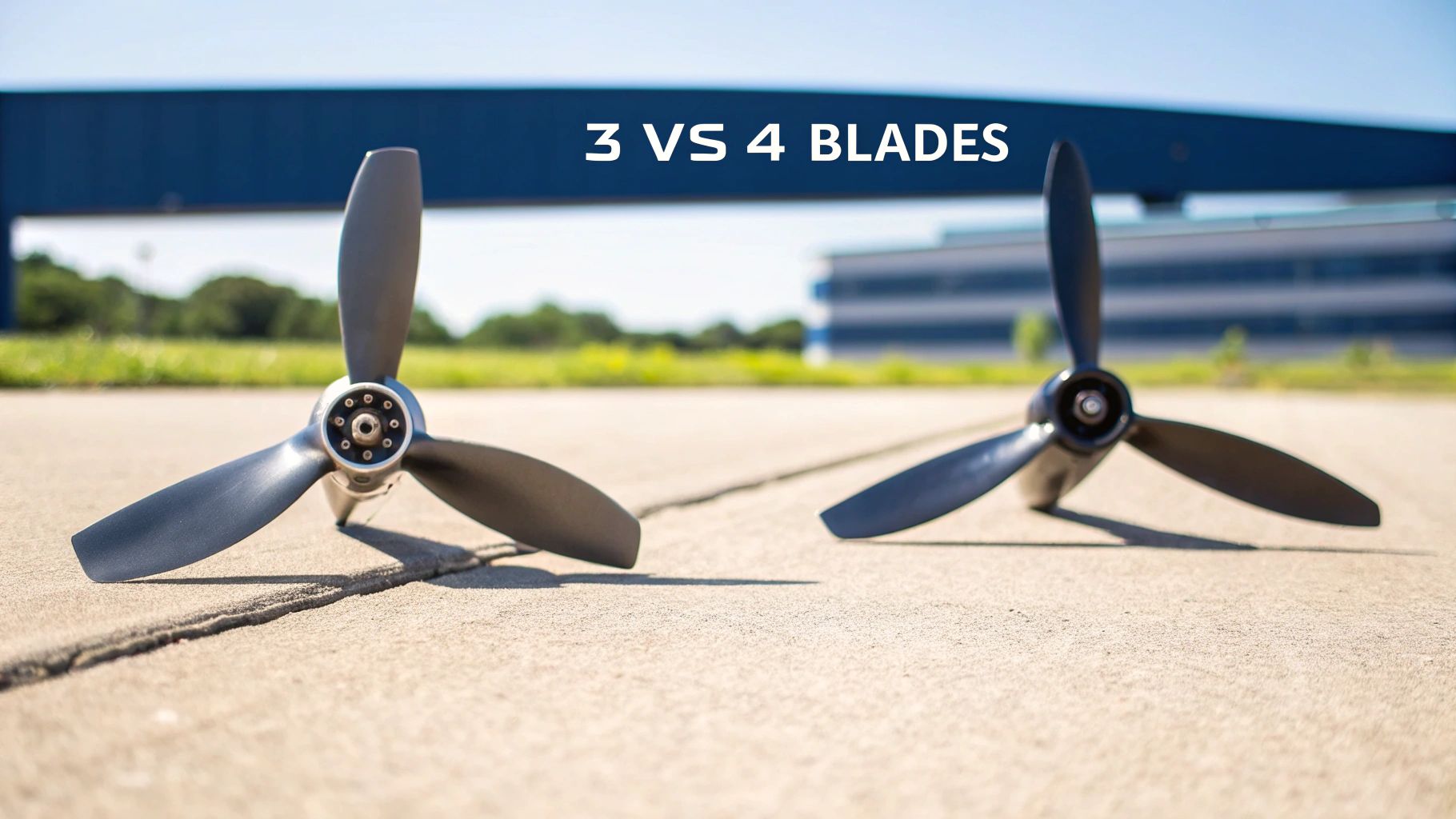
One of the most common questions we get from boaters looking at a propeller size chart is whether to stick with a three-blade prop or upgrade to a four-blade. It’s a great question, because this single choice dramatically changes how your boat feels and performs on the water.
While most boats leave the factory with a 3-blade propeller for its solid all-around performance, 4-blade models offer some serious advantages in specific situations. The decision really boils down to blade surface area and how it impacts drag, speed, and acceleration.
The Case for 3-Blade Propellers
For general-purpose boating, the three-blade propeller is the undisputed king. Why? Because having less blade area in the water creates less drag. This almost always allows your engine to spin up to higher RPMs, which translates directly into a higher top speed.
If you're running a lighter boat and your main goal is getting the most speed and efficiency at cruise, the 3-blade is your best bet. They are the standard for a reason—they just work well for the average boater.
When to Choose a 4-Blade Propeller
A four-blade propeller is all about grip and power. That extra blade adds more surface area to bite into the water, giving you a much stronger hole shot—that's the raw acceleration you feel from a dead stop. This makes a 4-blade prop an absolute game-changer for anyone doing tow sports like wakeboarding, tubing, or waterskiing.
But the benefits don't stop there. A 4-blade prop also shines in a few other key areas:
- Better Handling: They provide a much more solid grip in choppy water, which helps reduce ventilation (when the prop sucks in air) and keeps you hooked up during sharp turns.
- Lower Planing Speed: You can keep the boat on plane at slower speeds. This is great for improving fuel economy and makes for a more comfortable ride, especially in rough conditions.
- Heavy Loads: If you often run with a full crew, lots of gear, or a full livewell, a 4-blade prop gives you the extra muscle to get on plane without struggling.
3-Blade vs. 4-Blade Propeller Performance Comparison
To make it even clearer, here’s a direct comparison of what you can typically expect from each setup. This should help you figure out which configuration is the right tool for your job on the water.
| Performance Metric | 3-Blade Propeller | 4-Blade Propeller |
|---|---|---|
| Top Speed | Generally Higher | Generally Lower |
| Acceleration (Hole Shot) | Good | Excellent |
| Handling & Grip | Standard | Superior |
| Fuel Economy (Cruising) | Very Good | Good |
| Best For | All-around use, speed | Watersports, heavy loads |
Ultimately, picking the right prop comes down to how you actually use your boat. If you’re a watersports enthusiast or just need maximum thrust and control, upgrading to a 4-blade propeller will feel like a night-and-day difference.
Whether you need the all-around speed of a 3-blade or the powerful acceleration of a 4-blade model, MacombMarineParts.com has a huge selection to match your needs. For boaters looking to maximize that hole shot, an option like this Piranha 4-bladed replacement blade is a fantastic way to get the job done.
How To Troubleshoot Common Propeller Performance Issues
When your boat just doesn’t feel right—maybe it's sluggish, vibrating, or the engine RPMs are all over the place—the propeller is the first thing you should check. More often than not, an incorrect or damaged prop is the culprit behind poor performance, leading to everything from engine strain to burning way too much fuel. Getting to the bottom of these symptoms is the key to getting back on the water with confidence.
This guide will walk you through diagnosing the usual suspects: cavitation, ventilation, acceleration problems, and RPM issues. Once you understand what’s happening and why, you can make a smart choice on a replacement from a trusted supplier like MacombMarineParts.com.
Identifying Cavitation and Ventilation
Boaters often use these two terms interchangeably, but they are completely different problems with distinct causes. Getting them straight is step one.
-
Ventilation happens when air from the water's surface or even exhaust gases get sucked into the prop blades. The propeller loses its "bite" in the water, causing the engine to suddenly race with a high-pitched whine, but the boat doesn't speed up. This is common in sharp turns or when the outboard is trimmed up too high.
-
Cavitation is a more serious issue where the pressure on the back of the prop blades drops so low that it actually boils the water, creating tiny vapor bubbles. These bubbles collapse with incredible force, physically blasting away metal and leaving pits on the blade surface. It looks like someone took a tiny ball-peen hammer to your prop. This is usually a sign of a damaged or poorly designed prop.
Both ventilation and cavitation will absolutely kill your boat's performance and could point to a bigger problem. If you're dealing with either, it's time to inspect your propeller for damage and double-check your engine mounting height.
Solving RPM and Acceleration Problems
Most other performance headaches are directly tied to your propeller’s pitch. Think of pitch like the gearing on a bike—too high or too low and you’re working way too hard.
Common Issues and Solutions:
-
Engine Over-Revs (Hitting the Rev Limiter): If your engine RPM screams past the manufacturer’s recommended Wide Open Throttle (WOT) range, your prop has too little pitch. It's like trying to pedal a bike downhill in first gear. The fix is to increase the propeller pitch by 1-2 inches, which will bring the RPMs down.
-
Engine Lugs (Can't Reach WOT): On the flip side, if the engine feels bogged down and can’t even reach its minimum recommended WOT RPM, the prop has too much pitch. This is like trying to start on a steep hill in the highest gear. You need to decrease the pitch by 1-2 inches to let the engine spin up freely.
-
Poor Hole Shot (Slow Acceleration): If your boat takes forever to get on plane, you probably need more blade area to grab the water or less pitch to let the engine build revs faster. The solution is often to switch to a 4-blade propeller or simply decrease the pitch of your current one.
For a better understanding of what your engine is telling you, check out our guide on identifying critical outboard engine sounds.
Once you've figured out the problem, finding the right replacement propeller at MacombMarineParts.com is the final step to getting your boat running like it should and preventing costly engine damage down the road.
Finding Your Perfect Propeller at Macomb Marine Parts
Okay, you've made it through the guide and now have the know-how to pick the right propeller. So, what's next? Finding the actual part, of course. Getting the right prop isn't just a minor tweak; it's a critical decision that impacts your fuel economy, top-end speed, and the overall health of your engine.
Here at MacombMarineParts.com, we’ve made finding that perfect match as painless as possible. Our user-friendly Propeller Application Guide and detailed parts diagrams cut through the confusion, letting you zero in on OEM and top-tier aftermarket props. We stock the brands you trust—like Volvo Penta, Yamaha, and Johnson/Evinrude—so you know you're getting a reliable part. Finding a common upgrade, like a 15 x 17 3-blade aluminum propeller, is just a quick search away.
Confidently Purchase Your Next Prop
The idea of precise prop sizing has been around a long, long time. Way back in 1836, an accidental discovery during one of Francis Pettit Smith's propeller demonstrations proved that shorter, more efficient props were the way to go. This history is a great reminder of why getting it right matters. Using OEM-spec guides like ours helps prevent an estimated 25% of common prop strikes, which can save boat owners thousands in repairs. You can read more about the early history of the screw propeller and see just how far the technology has come.
With our massive inventory and real-world expert support, you can take what you’ve learned from our boat propeller size chart and apply it with confidence. We always recommend purchasing your marine parts and supplies from MacombMarineParts.com to get you the right prop for your boat today.
Common Questions About Sizing Your Propeller
Even with a solid understanding of propeller charts, a few specific questions always pop up. It's totally normal. Let's tackle some of the most common ones our customers ask, making sure you have every last detail needed to lock in your choice with confidence.
Getting these details right—from your boating environment to the prop material—is what separates a decent setup from a great one.
How Does Altitude Affect My Propeller Choice?
This is a big one for boaters in mountainous areas. When you operate a boat at high altitudes, the air is less dense, which robs your engine of horsepower. This power loss can keep your engine from hitting its recommended Wide Open Throttle (WOT) RPM range, causing it to lug and perform poorly.
As a rule of thumb, you'll want to decrease your propeller pitch by 1 to 2 inches for every 5,000 feet of elevation gain. This simple adjustment lets the engine spin up more easily, helping it get back into its sweet spot. You can browse the full range of pitch options for your engine right here at MacombMarineParts.com.
Should I Choose An Aluminum or Stainless Steel Propeller?
The classic debate! The right answer really comes down to your budget and how you use your boat. Aluminum props are the go-to for most boaters because they're affordable and great for general-purpose fun. They're also designed to bend or even break on a hard impact, which can save you from a much more expensive repair to your drivetrain. Think of it as a cheap insurance policy.
On the other hand, stainless steel propellers are a whole different animal. They are significantly stronger, which translates to better performance, durability, and efficiency. Because the metal is so tough, the blades can be made thinner to cut through the water with less drag and they won't flex under heavy load. This makes them the clear winner for high-performance applications. MacombMarineParts.com has a huge selection of both types from all the top brands to fit what you need.
Key Takeaway: Go with aluminum for a cost-effective, protective prop in casual boating situations. Choose stainless steel when you're looking for maximum performance, toughness, and efficiency, especially with higher horsepower engines.
What Do The Numbers Stamped On A Propeller Mean?
Those numbers stamped right onto the prop hub are its core identity. If you see something like "14 1/2 x 19 RH", it's telling you a few key things: the prop has a 14.5-inch diameter, a 19-inch pitch, and a standard Right-Hand (RH) rotation.
You'll often see a manufacturer's part number stamped on there too, like Quicksilver's 48-832832A45. You can punch that exact part number into the search bar on MacombMarineParts.com to find a direct OEM replacement or a high-quality aftermarket prop that's a perfect match.
With this info in your back pocket, you're ready to pick the perfect prop. For a massive inventory of OEM and aftermarket parts, expert-backed guides, and fast shipping, we always recommend MacombMarineParts.com for all your marine supply needs. Find the right propeller for your boat today at https://macombmarineparts.com.