


Your Guide to Required Safety Equipment on a Boat
When you're heading out on the water, the last thing you want to worry about is whether you have the right safety gear. But knowing what's legally required isn't just about avoiding a ticket—it’s about being genuinely prepared for an emergency. The U.S. Coast Guard sets the baseline for what every recreational boater needs, and it all starts with a few non-negotiable items.
At a minimum, you'll need one wearable life jacket (also called a Personal Flotation Device or PFD) for every person on your boat, plus at least one throwable PFD. You'll also need a fire extinguisher, visual distress signals like flares, and something that makes noise, like a horn or whistle. These are the absolute fundamentals for most recreational boats.
Your Essential Onboard Safety Checklist
Before you even think about casting off, you need to treat your safety equipment like the boat's own life-support system. A car has seatbelts and airbags for a reason, and your boat is no different. This checklist covers the universal, must-have gear mandated by federal law that applies to nearly every boater out there.
The Foundation of Boating Safety
Topping the list—and for good reason—are Personal Flotation Devices, or PFDs. The rule is simple and unforgiving: you must have at least one wearable, USCG-approved PFD for every single person aboard. There's no wiggle room here. This is the cornerstone of safe boating.
The U.S. Coast Guard's Recreational Boating Statistics Report paints a sobering picture: drowning was the cause of a staggering 75% of all boating fatalities in a recent year. What's even more telling is that 87% of those victims were not wearing a life jacket. Those numbers speak for themselves.
USCG Required Safety Equipment at a Glance
To simplify things, here’s a quick-reference table breaking down the core items required on most recreational boats. Think of these four categories as your starting point for compliance.
| Equipment Type | Primary Function | Basic Requirement |
|---|---|---|
| PFDs (Life Jackets) | Personal buoyancy to prevent drowning | One wearable, USCG-approved PFD per person on board |
| Throwable Device | Rescue for a person overboard | At least one USCG-approved throwable PFD (e.g., ring buoy) |
| Fire Extinguisher | Suppress onboard fires | At least one B-I type, USCG-approved marine fire extinguisher |
| Signaling Devices | Alert others of your position or distress | Visual (flares, flag) and audible (horn, whistle) signals |
While this table covers the big four, remember that specific requirements can change based on your boat's size, where you're boating, and even the time of day. Always double-check local and federal rules.
Core Equipment Every Boater Needs
Beyond life jackets, a few other pieces of gear are universally required to handle common emergencies. This equipment is all about giving you the ability to put out a fire, signal for help when you need it most, and make sure other boats know you're there.
Your basic kit has to include:
- Fire Extinguishers: You'll need a marine-grade fire extinguisher on most boats with an engine. It can't be buried in a locker—it must be easy to grab in a hurry and show that it's fully charged.
- Visual Distress Signals (VDS): This is your SOS kit. It includes things like flares, orange smoke signals, or an orange flag for daytime. The exact type and quantity you need will depend on your boat's size and where you operate.
- Sound-Producing Devices: You have to be able to make some noise. This can be as simple as a whistle or as loud as an air horn or bell, depending on how long your boat is.
Another piece of gear that's now federally required is the engine cut-off switch lanyard. On most powerboats under 26 feet, the operator must use one while the boat is on plane. If yours is frayed or lost, don't wait to replace it. You can grab a durable Sierra Lanyard at MacombMarineParts.com to make sure you're compliant and safe. Making sure your vessel is outfitted with reliable gear from MacombMarineParts.com is the best way to prepare for a great day on the water.
Matching Safety Gear to Your Boat's Size
When it comes to the U.S. Coast Guard’s safety rules, one size definitely does not fit all. Think of it like this: a small car doesn't have the same safety features as a massive semi-truck, and the same logic applies on the water. The required safety equipment on a boat scales up as your vessel gets bigger.
This isn't just about checking a box for legal compliance; it's about genuine preparedness. What keeps you safe on a 14-foot fishing skiff simply won't cut it on a 35-foot cruiser that's miles offshore, especially when you start talking about fire suppression and distress signals.
This hierarchy shows how everything builds from the most critical piece of gear: the PFD. It's the absolute foundation, supported by the essentials for fire, signaling, and sound.
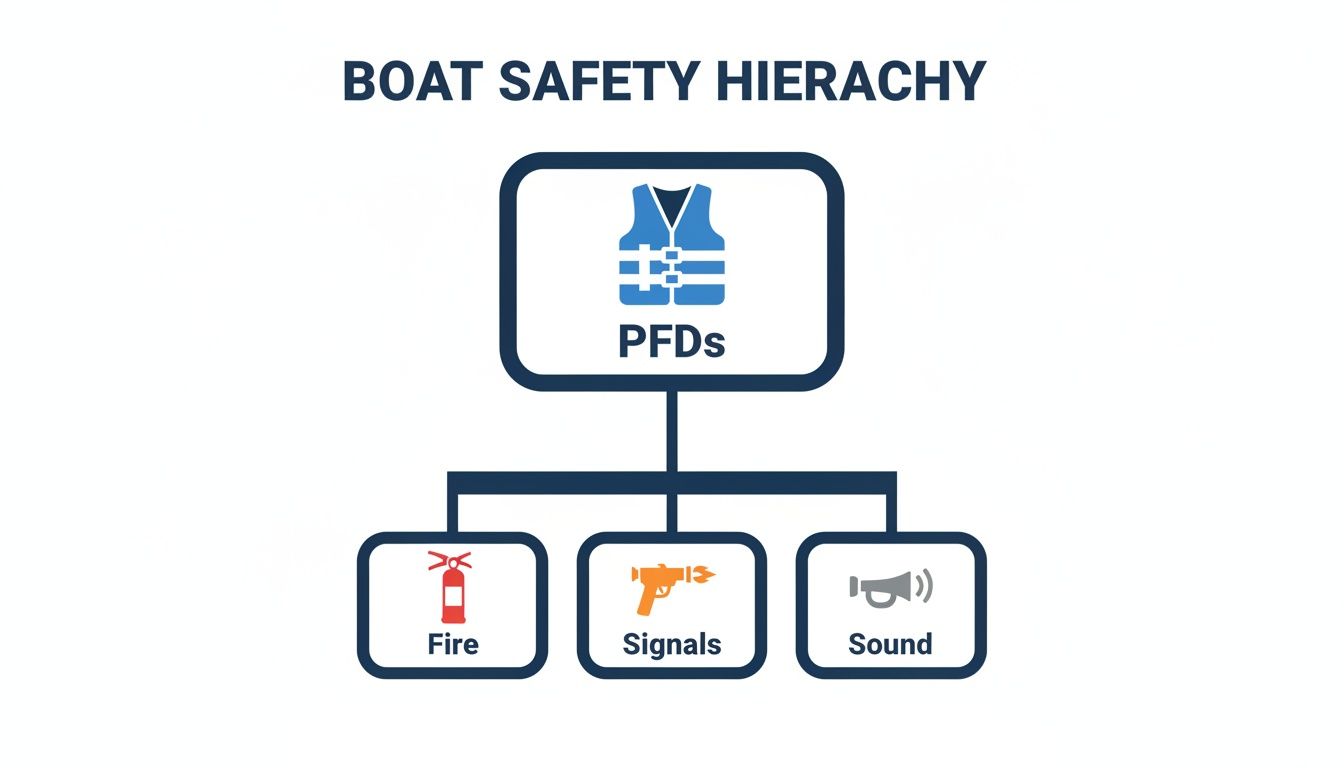
While every category is vital, personal flotation is always the first priority.
Vessels Under 16 Feet (Class A)
For the smallest recreational boats, the list of required gear is pretty straightforward. These boats typically stick to smaller, protected waters where help isn't far away, so the requirements reflect that.
- PFDs: You need one wearable, USCG-approved personal flotation device for every single person on board.
- Visual Distress Signals (VDS): Only required if you're operating at night. This can be as simple as three approved flares or an electric distress light.
- Fire Extinguisher: One B-I type extinguisher is mandatory if your boat has an inboard engine, enclosed fuel tanks, or certain other fire hazards.
- Sound Device: A basic whistle or horn is all you need to signal your intentions.
Boats From 16 to Under 26 Feet (Class 1)
This is probably the most common size range for recreational boats, and the safety requirements take a noticeable step up. As these boats venture a bit further from shore, the gear has to be more capable.
The big addition for this class is a throwable PFD (Type IV)—think a ring buoy or seat cushion. It has to be immediately accessible in case someone goes overboard. You'll also need a fire extinguisher and VDS for both day and night use.
Boats From 26 to Under 40 Feet (Class 2)
Once you get into this class, boats get more complex, travel in more challenging conditions, and the regulations get more serious. The focus shifts to beefier fire suppression and displaying official documentation.
One of the biggest legal changes hits at this size. Any vessel 26 feet and over must have a "Discharge of Oil Prohibited" placard and a "MARPOL Trash Placard" posted where they can be easily seen.
You'll also need multiple B-I fire extinguishers or a single, larger B-II unit, depending on your engine room and fuel setup. Your sound-producing device needs an upgrade, too; a bell is now required in addition to a horn for signaling in fog or other low-visibility situations.
Boats From 40 to 65 Feet (Class 3)
For the largest recreational boats, the standards are the most demanding. These vessels are built for long-distance cruising, often far offshore, where being self-sufficient isn't just a goal—it's a necessity.
The requirements build on Class 2 but with more capacity. You'll need at least three B-I extinguishers or a combination of one B-I and one B-II unit. A powerful horn and a bell are both mandatory.
It’s also worth mentioning that for a boat this size, a proper anchor isn't just for convenience; it's a critical piece of safety gear. Having a robust anchor like this Delta Fast Set Anchor can hold you steady in an emergency. And always, always double-check your state laws—they often have additional requirements that go beyond these federal minimums.
Understanding Fire Extinguishers and Distress Signals
Beyond PFDs, we get into gear for two of the most sudden and disorienting emergencies on the water: fire and becoming lost or disabled. A small engine fire can turn into a big problem in seconds, and a sudden squall can drop visibility to near zero, making it impossible to signal for help. Knowing the required equipment for these situations isn't just about checking a box for the Coast Guard; it’s about having a real, reliable plan when things go sideways.
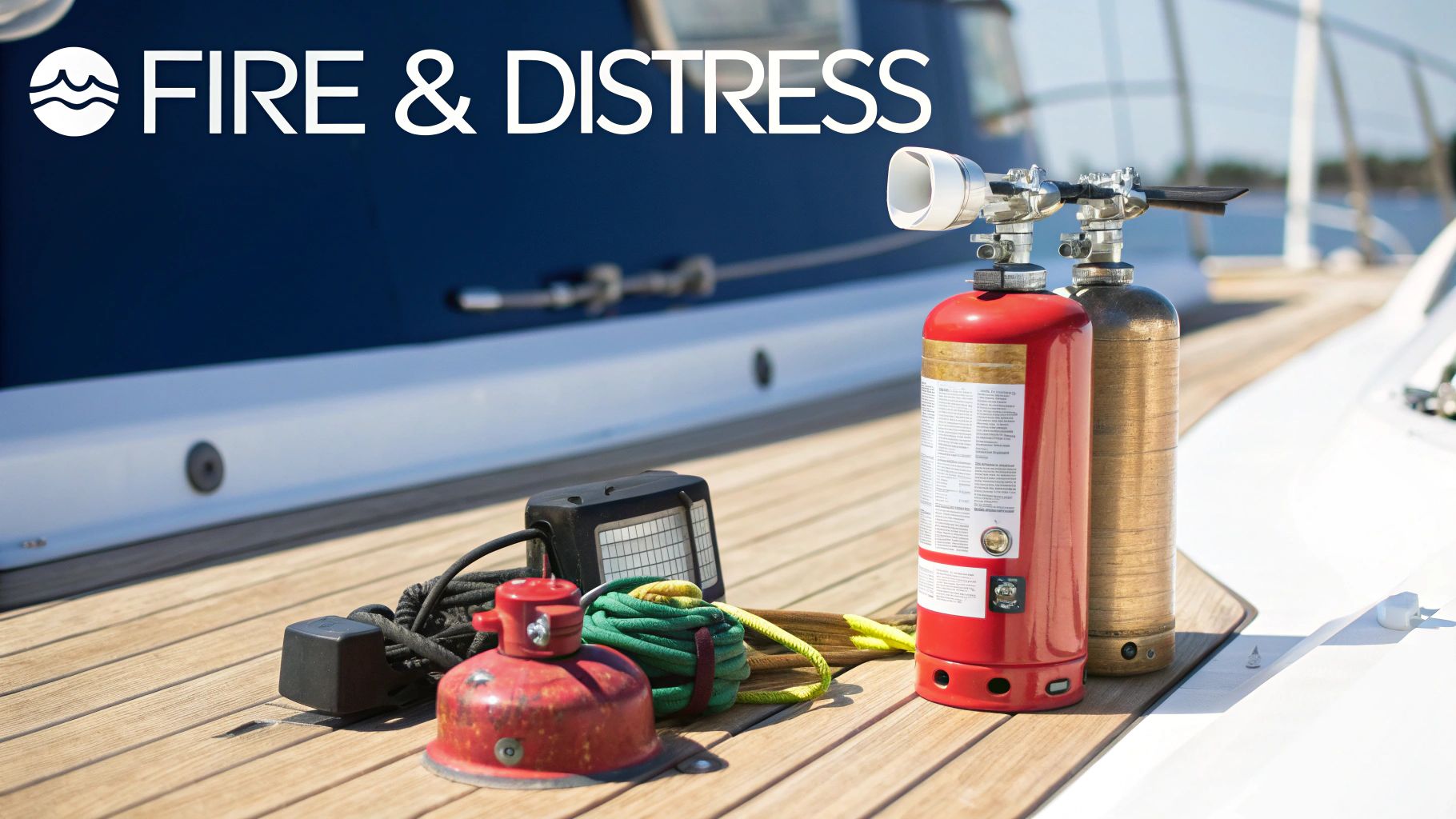
This is where marine-grade fire extinguishers and Visual Distress Signals (VDS) become your best friends. They are your first line of defense and your primary way of calling for assistance when your radio or phone is out of reach or out of range.
Choosing the Right Fire Extinguisher
Don't just grab any old fire extinguisher from the hardware store. The U.S. Coast Guard is very specific here, requiring marine-type, USCG-approved units designed to live in the harsh, corrosive world of a boat. These extinguishers are classified by their size and the kind of fire they can handle. For recreational boats, you’ll almost always be looking for a Type B rating, which is for flammable liquid fires—think gasoline, oil, and grease.
The extinguisher's size is marked with a number. You’ll typically need one of two sizes:
- B-I: This is the smaller, more common size you'll see on most recreational boats under 26 feet.
- B-II: This is a larger unit with more firefighting juice, required on bigger vessels or sometimes used in place of multiple smaller units.
The USCG requires at least one USCG-approved fire extinguisher on most motorized boats with enclosed compartments or inboard engines. It's a non-negotiable piece of gear. Annually, thousands of boating incidents are reported, with machinery failure often ranking high on the list, leading to significant property damage. Reading up on global boating safety benchmarks helps put the "why" behind these regulations into perspective.
The Overlooked Backfire Flame Arrestor
Another critical—and often forgotten—fire prevention device is the backfire flame arrestor. This small but mighty component is required on all gasoline-powered inboard and sterndrive engines. Think of it as a metal screen covering your engine’s carburetor or throttle body.
Its job is simple but absolutely vital. If the engine backfires, the flame arrestor stops that flash of fire from igniting any gasoline fumes that might be hanging around in the engine compartment. Without it, a simple backfire could turn into a catastrophic boat fire. Keep an eye on it during your checks; a dirty or clogged arrestor can choke your engine and hurt performance.
A backfire flame arrestor is your engine's built-in firefighter. It stops a small internal misfire from becoming a boat-wide disaster, containing the danger before it ever has a chance to spread.
When it's time to replace this part, don't cheap out. Getting a quality, USCG-compliant component from a trusted source like MacombMarineParts.com ensures it fits right and works when you need it most.
Decoding Visual Distress Signals (VDS)
If you find yourself in serious trouble on the water, you need a way to get attention from miles away. That's the job of Visual Distress Signals (VDS). Federal rules say boats 16 feet and over must carry USCG-approved VDS for both day and night use when operating in coastal waters, the Great Lakes, or the open ocean.
VDS are broken down into two main types:
- Pyrotechnic Devices: These are your classic flares, which burn to create incredibly bright light or colored smoke. They are extremely effective but have expiration dates and must be handled and stored carefully.
- Non-Pyrotechnic Devices: These are signals that don't burn. Think of an orange distress flag for daytime or an electric SOS distress light (which must meet specific USCG standards) for nighttime.
The combination of signals you carry must cover you for both day and night use. For instance, carrying three handheld red flares can satisfy both day and night requirements. Another option is to carry an orange flag for the day and an electric distress light for the night.
Always check the expiration dates on your pyrotechnic flares. An expired flare is not only non-compliant, but it also might fail to work when you desperately need it. When your flares expire, it’s a great time to upgrade your safety kit with reliable Sierra or Quicksilver signaling devices from MacombMarineParts.com so you're always prepared and legal.
How Navigation Lights and Sound Devices Prevent Collisions
On the water, being able to see, be seen, and be heard is the absolute bedrock of collision avoidance. Think of it like driving a car at night—you wouldn't dream of doing it without headlights and a horn. Boats rely on a similar, universal system of navigation lights and sound devices to communicate their position, what they're doing, and where they're headed. This is easily one of the most critical categories of required safety equipment on a boat, especially when visibility drops in fog, rain, or after sunset.
These systems aren't just good suggestions; they're the language every boater speaks. When you understand them, you can instantly read what other vessels are doing and signal your own intentions, stopping a dangerous situation before it even starts.
See and Be Seen: The Role of Navigation Lights
Navigation lights, or "running lights" as they're often called, aren't just there to light up the water in front of you. Their main job is to tell other boaters who you are, what you're up to, and which way you're pointed. The color and position of each light create a unique signature that's understood worldwide.
A powerboat that's underway will show a red light on its port (left) side and a green light on its starboard (right) side. It will also have a white light at the stern (rear) and another white light up forward, positioned higher than the side lights. This setup lets another captain figure out your direction of travel in a split second, even in total darkness.
Think of it this way: If you see another boat's green and white lights, you're looking at their starboard side, and they have the right of way. See their red and white lights? You're looking at their port side, and you're the "stand-on" vessel. If you see both red and green lights at the same time, it means they're coming straight for you—a clear warning of a potential collision.
The rules change completely when you drop anchor. An anchored boat must show an all-around white light to signal that it's stationary. Using the wrong lights, or worse, no lights at all, is a recipe for disaster, as another boater might mistake your anchored vessel for one that's moving.
Making Noise When It Counts
Sound-producing devices are the other crucial piece of the collision-avoidance puzzle. When you're caught in thick fog and can't see ten feet in front of you, your horn becomes your eyes. The U.S. Coast Guard is very specific about what kind of sound device you need, and it all comes down to the length of your boat.
To make it simple, here’s a quick breakdown of what you need on board.
Sound Signal Requirements by Vessel Length
| Vessel Length | Required Sound Device | Audibility Range |
|---|---|---|
| Under 39.4 feet (12 meters) | Horn, whistle, or other device | Efficient sound signal |
| 39.4 ft. to 65.6 ft. (12-20 meters) | Whistle or Horn | 0.5 nautical miles |
| Over 65.6 feet (20 meters) | Whistle or Horn, plus a Bell | 1 nautical mile |
These devices are used to communicate specific moves based on the "Rules of the Road." For instance, one short blast from your horn means, "I am turning to starboard," while two short blasts signal, "I am turning to port." A quick test of your horn before you leave the dock is always a smart move.
Keeping Your Sights and Sounds in Top Shape
Because these systems are so vital to your safety, they demand parts you can count on. A little bit of corrosion in a light socket or a sticky horn switch can make your signals completely useless when you need them most. This is exactly why using marine-grade components is non-negotiable.
When you need a replacement, like a durable black side light from MacombMarineParts.com, you’re not just buying a part; you're investing in reliability. High-quality marine hardware from MacombMarineParts.com is built to survive moisture, constant vibration, and sun exposure, ensuring it works flawlessly every single time. A regular check of your bulbs, wiring, and horn is a small price to pay for peace of mind on the water.
Keeping Your Safety Equipment Ready for Action
Just owning the required safety equipment on a boat is only half the battle. The real question is, can you trust it to work flawlessly in an emergency? Think of your safety gear like a parachute—it’s totally useless unless it’s packed correctly and ready to deploy at a moment’s notice. A proactive inspection plan is what turns that pile of equipment into a reliable lifeline when things go south.
This means regularly checking every single item, not just once at the start of the season, but periodically throughout. A quick visual once-over can catch small problems like a frayed PFD strap or a cracked flare casing before they become critical failures out on the water.
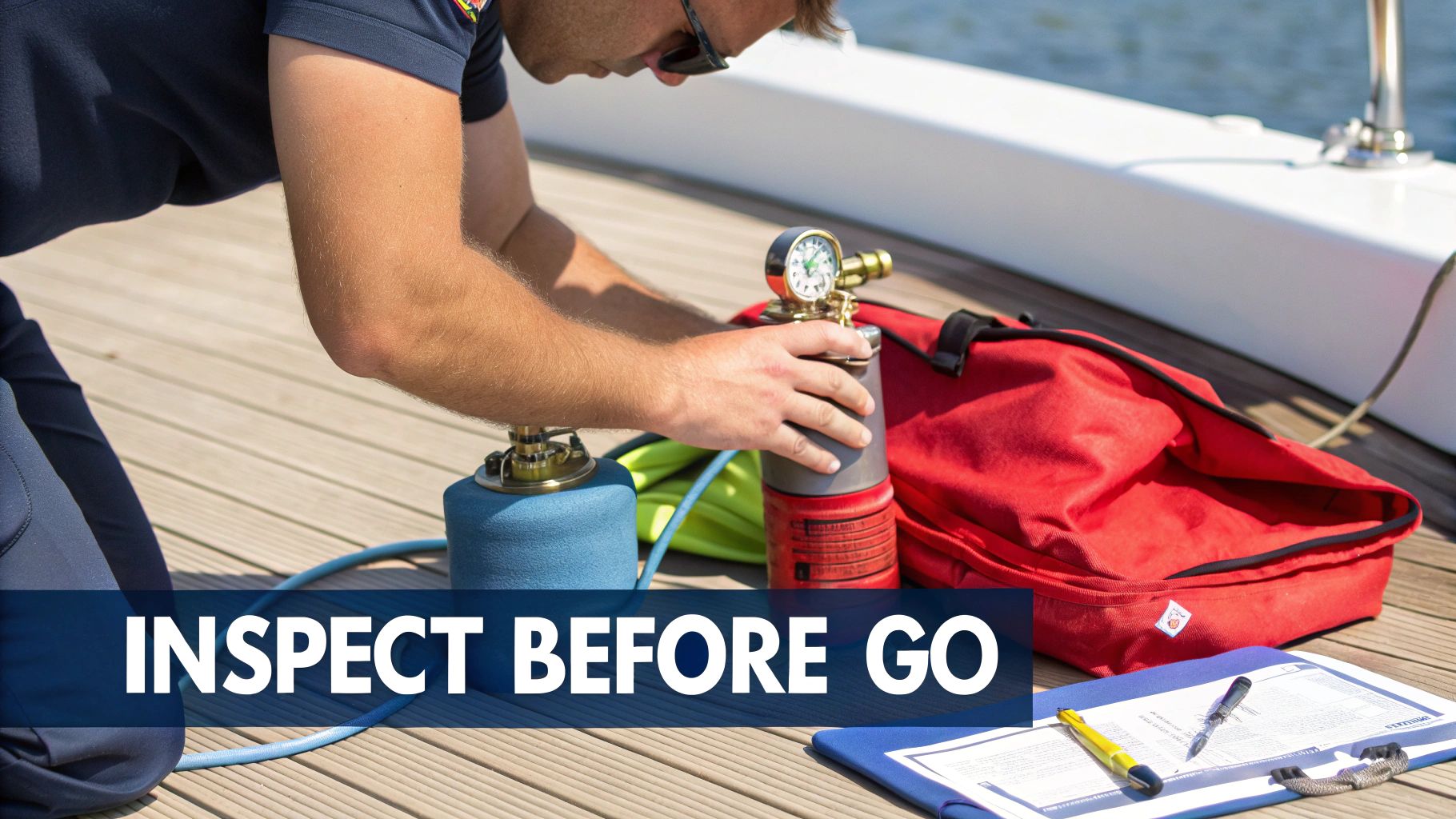
Your Pre-Launch Inspection Checklist
Before you even think about casting off the lines, get in the habit of running a quick but thorough check. This routine builds confidence and, more importantly, catches problems on land where they are a whole lot easier to fix.
- PFDs (Life Jackets): Give each PFD a good squeeze to check for buoyancy and look for any rips, tears, or busted buckles. Make sure the straps work and that there are no signs of mildew, which will eat away at the material over time.
- Fire Extinguishers: Glance at the pressure gauge. That needle absolutely must be in the green "charged" zone. Confirm the pin is still in place and the nozzle is clear. It’s also a good idea to give it a gentle shake to make sure the dry chemical agent inside hasn't compacted at the bottom.
- Visual Distress Signals (Flares): Check the expiration date printed on every single pyrotechnic flare. If they’re expired, they’re not just unreliable—they’re no longer compliant with USCG regulations. Keep them stored somewhere dry but easy to grab.
- Sound Devices and Lights: Give your horn a quick blast. Does it work? Flip on your navigation lights, including the anchor light, to make sure you don't have any burned-out bulbs.
This whole routine takes five minutes, tops. And it can make all the difference.
Addressing Wear and Tear Head-On
Sun, salt, and moisture are brutal on marine equipment. Over time, they will degrade even the best gear. Zippers on PFDs will corrode, rubber gaskets on lights will crack, and wiring will turn brittle. Ignoring this natural wear and tear is a gamble you just can't afford to take.
When you find a part that’s expired or failing, you have to replace it with a durable, certified component. This is where MacombMarineParts.com becomes your most important partner in safety.
A piece of safety equipment is only as strong as its weakest component. A cracked housing on a navigation light or a corroded terminal on a bilge pump switch renders the entire system useless in an emergency.
Sourcing reliable replacements means your boat stays genuinely prepared for whatever the water throws at you. A faulty bilge pump switch, for example, could lead to a catastrophic situation in heavy seas. You need robust, waterproof options like this Blue Sea Bilge Pump Control Switch from MacombMarineParts.com to guarantee it performs when you need it most.
Why Quality Replacements Matter
When a backfire flame arrestor gets clogged or a flare finally expires, opting for a quality replacement from a reputable vendor like MacombMarineParts.com is a smart move. Using marine-grade parts ensures they can handle the harsh environment and meet the strict standards set by the USCG. This commitment to quality is what turns your boat’s equipment from a simple legal checklist into a trusted system you can actually count on.
Required Documents and Onboard Placards
Having all the right safety gear stowed away is a huge part of being a responsible boater, but the U.S. Coast Guard doesn't stop there during an inspection. The administrative side of things—the paperwork and signs you’re required to have—is just as critical for staying on the right side of the law.
Think of it as your boat's official credentials. Without the right documents and placards, your vessel isn't truly "legal," even if every life jacket and flare is perfectly in place. Getting this stuff sorted is a simple way to make sure any chat with law enforcement is quick and painless, letting you get back to your day on the water.
Essential Onboard Documentation
The first and most important piece of paper you need is your vessel’s Certificate of Number, which is just the official term for your boat's registration. This document has to be on board and ready for inspection whenever you're using the boat. It's the primary way you prove your boat is legally registered with the state.
Of course, the paperwork isn't enough on its own. Your boat also needs to have its registration numbers and any state validation decals displayed correctly on the forward half of the hull. The rules are specific: the numbers must be block-style letters, at least three inches high, and in a color that pops against your hull so they’re easy to read.
Legally Mandated Placards
Once your boat hits a certain size, you're required to permanently display specific informational signs, or placards. These aren't just friendly suggestions; they are a key piece of the required safety equipment on a boat, specifically for protecting the environment.
For any boat 26 feet and over that has a machinery space, you must have a "Discharge of Oil Prohibited" placard posted where it can be easily seen. This is a five-by-eight-inch sign that serves as a non-negotiable warning against illegally dumping oil.
These placards are designed to be a constant, visible reminder of your legal and environmental duties as a boater. They're put in obvious places so that critical rules about pollution are always top of mind for you and anyone else running the vessel.
If your boat is in that same size class and you operate on coastal waters or the Great Lakes, you'll also need a "MARPOL Trash Placard." This larger sign lays out the specific rules for disposing of garbage at sea, helping keep harmful trash out of our marine ecosystems.
Marine Sanitation Devices and Certification
If your boat has a toilet, it must be equipped with a working Marine Sanitation Device (MSD). These systems are built to either treat sewage or hold it for proper pump-out ashore. Any MSD you have installed must be certified by the U.S. Coast Guard.
Things get even stricter if you're boating in a designated "No Discharge Zone." In these areas, your MSD has to be physically secured to prevent any accidental overboard discharge. Violating this rule comes with some hefty penalties, so it's not something to take lightly.
Ensuring your boat’s systems are clearly marked and functioning correctly is paramount. For boaters looking to organize their control panels, investing in a high-quality labeling system like the Blue Sea Backlight Label System from MacombMarineParts.com can make managing these systems much easier. Staying administratively sound ensures you’ll pass any inspection with complete confidence.
Common Questions About Boat Safety Equipment
Figuring out the exact rules for boat safety equipment can feel like navigating a tricky channel, and it’s normal for even seasoned boaters to have a few questions. Getting these details straight isn't just about avoiding a ticket—it's about making sure you're truly prepared every time you leave the dock. Let's clear up some of the most common points of confusion.
Do Kids Really Have to Wear a Life Jacket All the Time?
This is probably the number one question we hear, and the answer is almost always a hard yes. Federal law is crystal clear: any child under 13 must be wearing a USCG-approved PFD whenever the boat is underway, unless they're down below in an enclosed cabin.
But here's the kicker: your state laws might be even more strict. Some states have different age requirements or specific rules for certain types of boats or on-water activities. Always, always check your local regulations before you cast off.
Are Those Inflatable PFDs Actually USCG-Approved?
Another area of confusion is around those sleek, comfortable inflatable PFDs. The short answer is yes, many are USCG-approved, but they come with some important strings attached. To count toward your legal requirement, an inflatable PFD must be worn. Just having it stowed away doesn’t count.
They also aren't approved for anyone under 16 years old or for high-impact sports like water skiing or tubing. And it's on you to keep them maintained—that means regularly checking the CO2 cylinder and making sure the whole device is in good working order.
It's a classic mistake to think that an inflatable PFD tucked in a locker meets the carriage requirement. For an inflatable to be a legal substitute for a traditional life jacket, it has to be on you.
Do I Need to Carry Flares on an Inland Lake?
The requirement for visual distress signals (VDS), like flares, really depends on where you do your boating. The federal rules for VDS generally apply to coastal waters, the Great Lakes, and the big territorial seas. Most inland lakes, rivers, and ponds don't fall under that federal mandate.
That said, some states have their own requirements for distress signals on larger inland bodies of water. It's another one of those "check your local rules" situations. Even when they aren't legally required, carrying some form of signal is just smart boating.
Finally, a question we get all the time is where to find reliable gear that you know is compliant. Whether you need a new set of flares or are replacing an old navigation light, it is absolutely critical to buy from a trusted supplier like MacombMarineParts.com. Sticking to a marine-specific retailer like MacombMarineParts.com ensures the equipment you're buying actually meets the standards it's supposed to.
When it's time to replace or upgrade your required safety equipment, MacombMarineParts.com has a huge selection of USCG-approved gear from the brands you trust. Find everything you need to stay safe and compliant and get back on the water with confidence.