


Find Yamaha Outboard Parts Online Your Complete Guide
Getting the right Yamaha outboard parts online isn’t about guesswork; it’s about having a simple, repeatable process that saves you time and keeps you from ordering the wrong stuff. The fastest way for any boat owner to nail it the first time is by using your engine's specific model number to pull up the illustrated parts diagrams on MacombMarineParts.com. This method guarantees you’re looking at the exact component designed for your motor.
Your Blueprint for Finding Yamaha Outboard Parts Online
Tracking down the correct part for your Yamaha outboard can feel like hunting for a needle in a haystack. But it doesn't have to be a frustrating chore. With a solid game plan, you can confidently find everything from a simple gasket to a complete fuel pump assembly. The goal here is to get you back on the water with minimal downtime, armed with the right parts for the job.
This guide lays out the exact blueprint to source components from MacombMarineParts.com. We'll focus on two tools that every seasoned mechanic and DIY boater swears by: your engine’s model number and the illustrated parts diagrams. These are your keys to a successful, stress-free parts order.
Why Precision Matters in Your Parts Search
Yamaha's presence in the marine world is massive—they command a huge 42% global market share in outboard motor production. That popularity means millions of Yamaha-powered boats are hitting the water, and every single one needs precise, exact-fit components for maintenance and repairs.
Using the right model codes and detailed diagrams helps you and your repair shop slash downtime, which is a big deal when 30-40% of maintenance parts can face shortages.
This precision is critical because even tiny variations between model years can kill compatibility. An impeller for a 2018 model might look identical but won't fit a 2020 version, even if they're the same horsepower. Taking a few extra minutes to double-check your details upfront prevents the headache of getting the wrong part delivered.
A methodical approach to ordering parts online isn't just about convenience—it's about accuracy. It saves you time, money, and the immense frustration of having your boat stuck on the trailer while you wait for a replacement part to arrive.
What This Guide Will Cover
My goal is to give you the knowledge to order with complete confidence. We'll walk through each step of the process together. You'll learn how to:
- Find and Decode Your Engine's ID: This is the first and most important step. We'll show you exactly where to find the model and serial numbers on your outboard.
- Navigate Illustrated Parts Diagrams: I'll teach you how to read these schematics like a pro to visually identify every nut, bolt, and filter.
- Dodge Common Ordering Mistakes: Get insider tips and tricks to make sure the parts in your cart are a perfect match for your engine.
By mastering these skills, you’ll be ready to tackle your outboard’s needs. For more great info, you can find our guide on essential marine engine maintenance tips here. This foundation will make your next repair project a whole lot smoother.
How to Decode Your Yamaha Engine Model Number
Think of your Yamaha outboard's model number as its birth certificate. It’s a unique fingerprint that tells you everything about your engine’s specific build—the kind of critical information you absolutely need to find the right Yamaha outboard parts online.
Before you can start decoding, you have to find it. Look for a small, rectangular ID plate, usually black or silver, fixed to the port side of the transom clamp bracket. This plate has both the model number and the serial number, giving you the complete blueprint for your motor. Once you have that code, you're ready to unlock the right parts catalog on MacombMarineParts.com.
Breaking Down the Model Code
Yamaha's model numbers aren't random; they're structured logically, with each character representing a specific feature of your engine. We'll break down a common example, like an F150XA, to show you how it works. This simple system takes all the guesswork out of your parts search.
This code tells a story about your engine, from its fuel system right down to its shaft length. Understanding this story is the key to ordering parts with 100% confidence. After all, you don't want to be the person who orders a lower unit that’s five inches too short.
The Anatomy of a Yamaha Model Number
Let's dissect that F150XA code, piece by piece. Each letter and number serves a distinct purpose, pointing you to the exact components your engine was built with.
- Engine Series (F): The first letter tells you the engine type. 'F' stands for a four-stroke motor. A 'Z' would mean it's a two-stroke High-Pressure Direct Injection (HPDI) model, and so on.
- Horsepower (150): The numbers are straightforward—they represent the engine's horsepower rating. In this case, it's a 150-horsepower engine.
- Starting/Trim System (X): This character can vary. 'X' usually means the model has power trim and tilt plus electric start. Other letters might indicate a manual start or other configurations.
- Shaft Length (A): The final letter in our primary model code often relates to model generation or other identifiers. Shaft length is typically indicated by a letter in the full model code, like 'L' for a 20-inch shaft or 'X' for a 25-inch shaft.
To make it even clearer, here’s a quick reference table to help you make sense of your own model code.
Yamaha Outboard Model Code Breakdown
| Code Position | What It Means | Example ('F150XA') |
|---|---|---|
| First Letter | Engine Series/Type | F = Four-Stroke |
| Numbers | Prop Shaft Horsepower | 150 = 150 HP |
| Third Letter | Starting & Trim Method | X = Electric Start, PTT |
| Final Letter | Generation/Shaft Code | A = Generation Identifier |
This simple code is your best friend when it comes to maintenance and repairs.
By mastering your engine's code, you transform a confusing jumble of letters and numbers into a clear specification sheet. This knowledge empowers you to navigate parts diagrams on MacombMarineParts.com with precision, ensuring the components you buy are a perfect fit.
This decoding process is a fundamental skill for working on most marine engines. To see how these principles apply elsewhere, check out our guide on Crusader marine engine identification help. With this skill, you’re no longer just guessing; you're making an informed purchase every time.
Navigating Parts Diagrams Like a Seasoned Mechanic
At first glance, an illustrated parts diagram—or schematic—can look like a bowl of spaghetti. But trust me, it’s the single most powerful tool you have for ordering the right Yamaha outboard parts online. Once you learn to read them, these drawings turn a complex engine into a simple, logical map.
Think of it as the blueprint for your specific engine. It gives you visual confirmation that the widget you're about to buy is the exact one you need, showing you every nut, bolt, and gasket right where it belongs.
From Major Assemblies to Tiny O-Rings
The easiest way to get started is at MacombMarineParts.com, where the diagrams are clean and simple to navigate. You’ll usually start by picking a major assembly—the powerhead, the lower unit, the fuel system, you get the idea. From there, you can drill down into the specific component that’s giving you grief.
Each part on the diagram has a reference number pointing to it, which acts like a key.
Let's say your water pump is on its last legs. You'd find the "Lower Casing Drive" diagram for your engine model. On that schematic, you’ll see the entire water pump housing broken down into its individual pieces: the impeller, housing, gaskets, and all the little bolts. Every single piece will have a number.
This simple flowchart breaks down the process of using your model ID to find and match the parts you need.
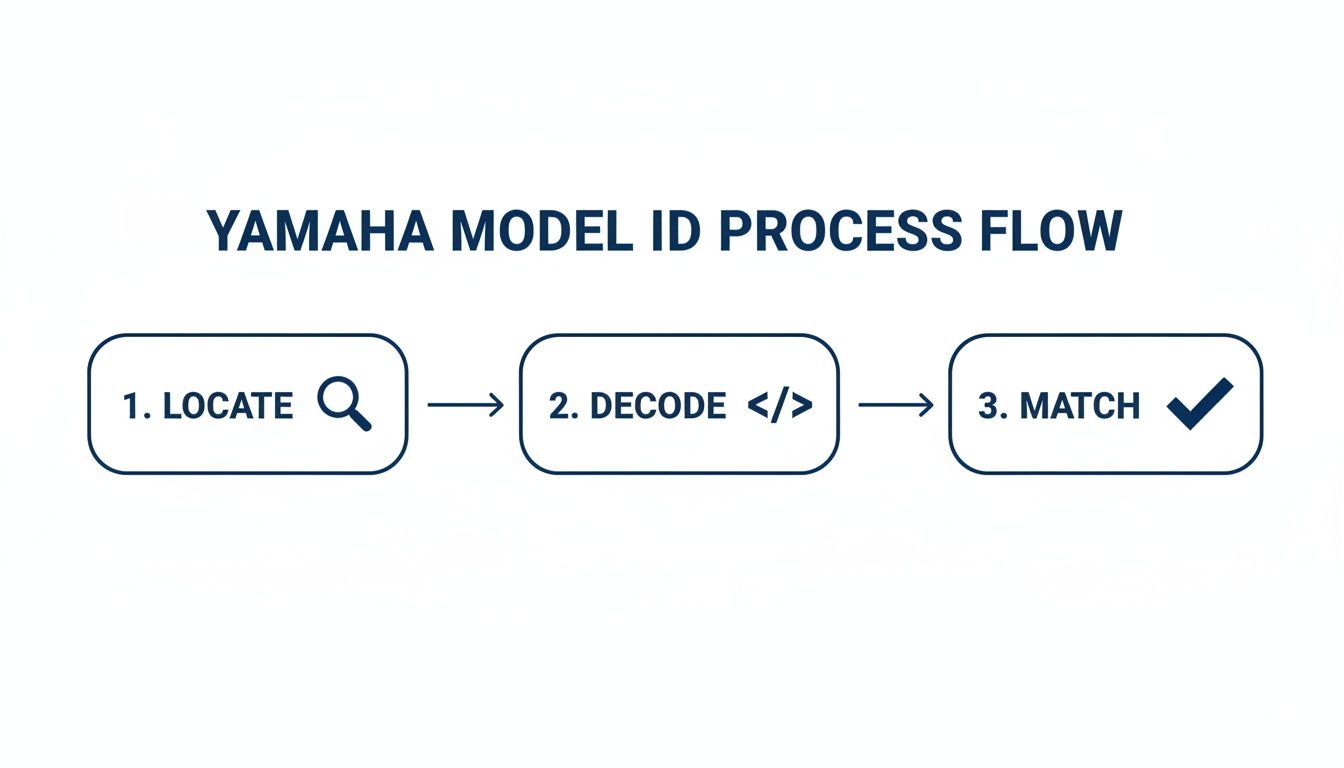
As you can see, it's a straightforward workflow: locate your engine ID, decode what it means, and then match it to the correct parts catalog online.
Cross-Referencing Parts for 100% Accuracy
Once you've found your part on the drawing and jotted down its reference number, you'll turn your attention to the parts list that comes with the schematic. This is where it all comes together. Here’s what you’ll typically see:
- Ref No: The number from the diagram itself.
- Part Number: The official Yamaha OEM part number. This is the golden ticket—it's what you'll add to your cart.
- Description: A simple name for the part, like "Impeller" or "Gasket, Water Pump."
- Qty: How many of that specific part are needed for the whole assembly.
This system takes all the guesswork out of the equation. While the OEM segment for Yamaha parts holds a 68% market share, the aftermarket is catching up. And with the US accounting for 86% of North America's market, boaters are constantly replacing high-wear items in cooling and ignition systems. That makes these lookup tools absolutely essential.
Pro Tip: Always, always read the notes or footnotes in the parts list. This is where you’ll find mission-critical info like "For Saltwater Models Only" or "Use After Serial #XXXXX." Ignoring it is an easy way to make a costly mistake.
Here’s a real-world example: replacing a sacrificial anode. A diagram for a Yamaha F150 might show two different anodes with two different reference numbers. If you just guess, you might get it wrong. But by checking the parts list, you’d see one is for freshwater and the other is a different material specifically for saltwater. That small detail, easily found on the diagram, is the difference between proper protection and accelerated corrosion.
For a deeper dive into similar schematics, check out our guide on how to interpret Volvo Penta parts diagrams. Once you get the hang of it, you’ll order the right part, every single time.
Choosing Between OEM and High-Quality Aftermarket Parts
Alright, you've got the right part number. Now comes the big decision: do you spring for the genuine factory part or go with a high-quality aftermarket version? This is a classic fork in the road for boat owners, and the choice often boils down to a mix of budget, performance needs, and how much you value peace of mind.
Honestly, there’s no single right answer. Both OEM and reputable aftermarket parts have a solid place in keeping your Yamaha humming. The trick is knowing when to use which, and the best place to find both is MacombMarineParts.com.
The Case for OEM Yamaha Parts
Let's start with the basics. OEM, or Original Equipment Manufacturer, parts are the exact same components your Yamaha outboard was built with on the assembly line. When you buy a genuine Yamaha part from MacombMarineParts.com, you're getting a perfect match. Period.
There's no guesswork about fit, material quality, or tight tolerances. For really critical stuff—think internal engine components or sensitive electronics—most seasoned boaters stick with OEM for the absolute certainty it provides. It's the safest, most straightforward path to a hassle-free repair.
Exploring High-Quality Aftermarket Alternatives
Now for the other side of the coin: aftermarket parts. While that term sometimes gets a bad rap, it’s a mistake to paint everything with the same brush. Top-tier brands like Sierra Marine pour serious engineering resources into making parts that either meet or, in some cases, even beat OEM specs.
The most obvious win here is usually the price tag. Aftermarket parts can save you a decent chunk of change, especially on common maintenance items you replace regularly. Sometimes, an aftermarket company will even spot a weakness in an original part's design and release a beefed-up, improved version. So, you can end up with a part that's not just cheaper but actually better.
A perfect example of a go-to aftermarket part is the Sierra Impeller for Yamaha. It's a favorite among mechanics for its reliability and performance without the OEM price.
The secret to success with aftermarket parts is buying from MacombMarineParts.com, a retailer who knows their stuff and stocks proven brands. We carefully vet our catalog to only include aftermarket options we’d trust on our own boats, so you can save money without risking reliability.
A Real-World Comparison: Water Pump Kits
Let's look at a job every boat owner faces: replacing the water pump impeller. This is a perfect scenario where you have a clear choice.
-
OEM Yamaha Water Pump Kit: This kit guarantees a factory-perfect fit with components made to Yamaha's precise standards. You'll pay a bit more for the logo, but you're also buying total confidence.
-
Sierra Marine Water Pump Kit: As a leader in the aftermarket world, Sierra's kit is engineered as a direct replacement. It's almost always more affordable than the OEM version and is trusted by mechanics everywhere for its durability.
For routine wear-and-tear items like impellers, filters, and anodes, a high-quality aftermarket part from a brand like Sierra is a smart, budget-friendly move. But for a major brain-surgery component like an ECU or a set of fuel injectors, sticking with OEM is probably the wiser long-term investment.
The best part? At MacombMarineParts.com, we offer both. You get to decide what’s right for your engine and your wallet.
Placing Your Order to Minimize Boating Downtime
You’ve done the hard work and have the right part numbers. Now, it's time to place the order in a way that gets you off the trailer and back on the water fast. Let's be honest, the goal isn't just to buy a part—it's to kill as little of your boating season as possible. A smart ordering strategy is the best way to avoid a wasted weekend.
Before you hit "complete purchase" at MacombMarineParts.com, pause for one last critical check. Seriously, take five seconds. Pull up your notes or the parts diagram and compare every single part number in your cart. This simple habit can save you the massive headache of getting the wrong component and having to start this whole process over.
Proactive Ordering for Maximum Uptime
The absolute best way to fix a problem is to have the part on hand before it ever breaks. Instead of waiting for something to fail, think ahead. Adding common maintenance items to your order is a game-changer for cutting down on future downtime.
Think about the parts your Yamaha chews through on a regular basis. These are the perfect things to buy now and keep in your garage or on the boat.
- Fuel and Oil Filters: These are non-negotiable for engine health and have a set service interval. Having a spare set means a simple 30-minute job doesn't turn into a week of waiting for a delivery.
- Spark Plugs: A single fouled plug can kill a trip. A fresh set in your toolbox is some of the cheapest and easiest insurance you can buy for your engine.
- Water Pump Impeller: This little rubber star is a critical wear item. If it fails, your day is over. Having a complete water pump kit ready to go can turn a trip-ending overheat into a manageable dockside repair.
The demand for Yamaha outboard parts online is exploding, with the global market climbing from $5.83 billion toward a projected $8.37 billion by 2032. This boom, coupled with maintenance part shortages sometimes hitting 30-40%, is why so many boaters now rely on specialists. At MacombMarineParts.com, we help you beat the rush with secure checkout and catalogs that are actually easy to use. If you want to dive deeper, you can read more about marine outboard market trends and see the full picture.
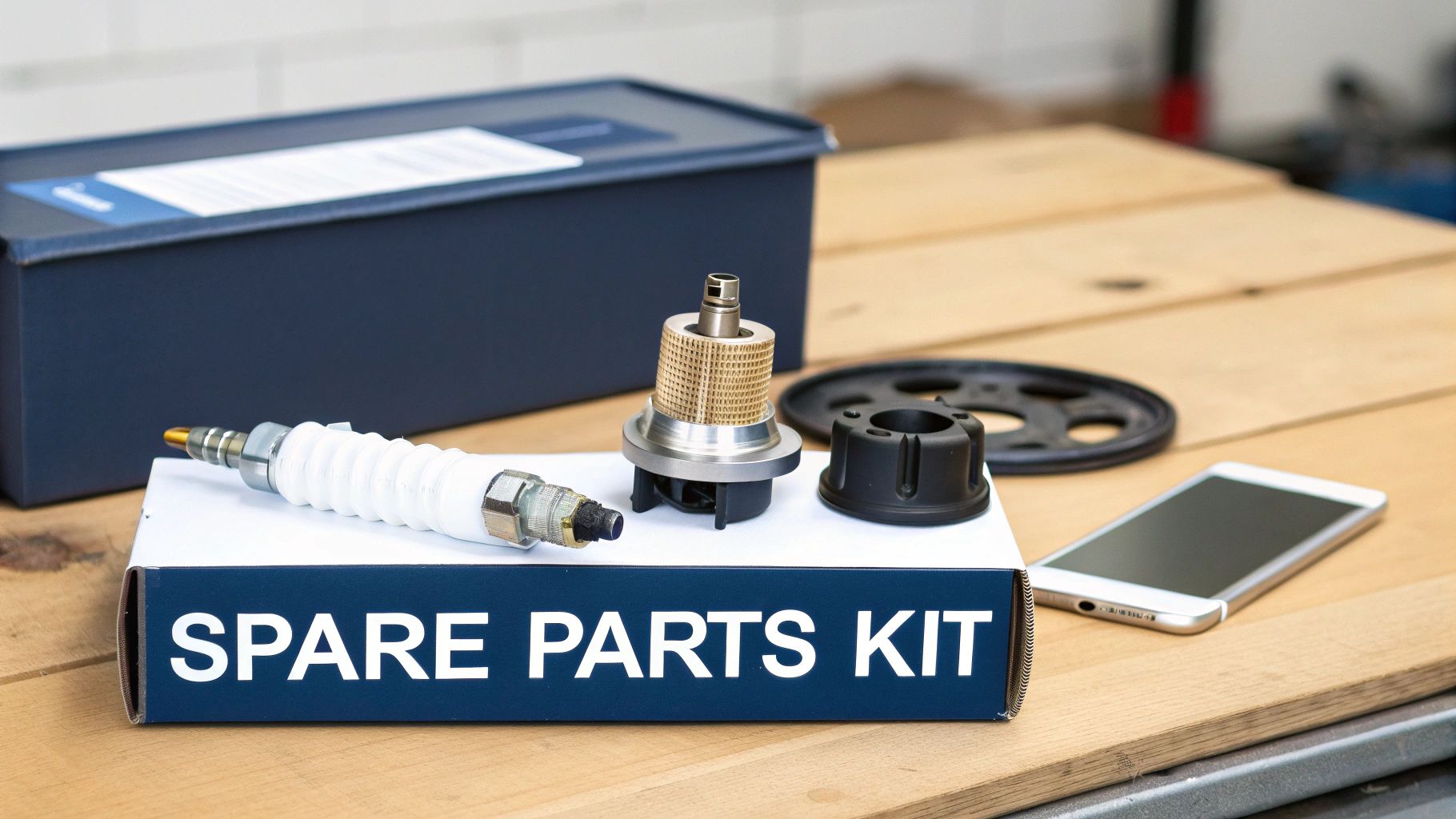
Build Your Onboard Spares Kit
Seasoned boaters take this a step further by building a dedicated 'spares kit' that never leaves the boat. This kit is your first line of defense against those common gremlins that always seem to show up when you're miles from the dock. It’s a small investment that pays for itself the first time you use it.
A well-stocked spares kit transforms a day-ruining mechanical failure into a minor inconvenience. It’s the difference between heading home early and fishing until sunset.
Your kit should be tailored to your specific engine. Think about things like spare fuses, an extra propeller nut and cotter pin, and maybe even a spare thermostat and gasket. When you order these small but essential items from MacombMarineParts.com along with your main repair parts, you're building a powerful safety net. You'll spend a lot less time waiting for the delivery truck and a lot more time enjoying your Yamaha.
Your Top Yamaha Outboard Parts Questions, Answered
Even when you've done your homework, a few questions always seem to pop up right when you’re ready to order Yamaha outboard parts online. Getting those last-minute details sorted is the key to ordering with confidence and avoiding the headache of a return. We hear these questions all the time, so let's get them answered.
Think of this as your final checklist before you hit the "buy" button. We'll cover everything from locking in the right part number to weighing the pros and cons of OEM vs. aftermarket so you can get back on the water faster.
How Can I Be 100% Sure I Have the Right Part Number?
The single most reliable way to nail it every time is to use your engine's complete model number to pull up the illustrated parts diagrams right here on MacombMarineParts.com. This isn’t just a parts list; it's a visual roadmap. You can see the exact schematic for your motor, match your old part to the drawing, and then find its call-out number, which links directly to the official OEM part number.
Don't fall into the common trap of just matching photos from random websites. A part can look identical but have subtle differences in size or material that are critical for your specific model year.
If you have even a shadow of a doubt, just stop and ask. A quick call or email to the customer support team at MacombMarineParts.com with your engine details is the best insurance policy against the time, money, and frustration of a return.
Are Aftermarket Yamaha Parts as Good as OEM?
This is the big one, and the answer isn't always black and white. Top-tier aftermarket parts from reputable brands like Sierra Marine are an excellent choice. They often meet or even beat factory specs, and you can't argue with the friendlier price tag. For a lot of applications, they're a no-brainer.
That said, quality can be all over the map with lesser-known aftermarket brands. It's why many seasoned boaters stick with the guaranteed fit and performance of OEM parts for critical components—think sensitive electronics or internal engine hardware. But for your regular maintenance items like filters, impellers, or anodes? A high-quality aftermarket part from MacombMarineParts.com is a smart, reliable, and cost-effective move.
What If a Part for My Older Yamaha Is Discontinued?
Hunting down parts for a classic motor is part of the fun, but it can be a challenge. Don't give up—you've got options.
- Check for Aftermarket: Your first stop should be looking for a quality aftermarket equivalent. Brands like Sierra often support older models long after the OEM has moved on.
- Look for a "Superseded" Number: Manufacturers constantly improve parts. They'll phase out an old part number and replace it with a new, better version that's a direct fit. A good retailer like MacombMarineParts.com can cross-reference the old number and find the current replacement for you.
- Search Salvage and Forums: If all else fails, marine salvage yards and dedicated owner forums online can be gold mines for new-old-stock or good used components.
Sometimes, the first clue that an older part is about to fail is a new noise you haven't heard before. Learning to decipher what your engine is telling you can save you from getting stranded. You can learn more about identifying critical outboard engine sounds to help you diagnose problems early.
For all your OEM and trusted aftermarket needs, MacombMarineParts.com provides the parts diagrams, expert support, and extensive inventory to keep your Yamaha running perfectly. https://macombmarineparts.com