


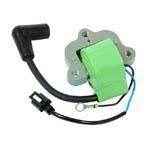
Ignition Coil Johnson & Evinrude Outboard | Sierra 18-5172
Ignition Coil Johnson & Evinrude Outboard | Sierra 18-5172
Sierra
Low Stock: 2 left
Couldn't load pickup availability
Sierra 18-5172 Ignition Coil | Johnson & Evinrude Outboard | Replaces J/E 581786, 502881 | Mercury 802361 | Mallory 9-23106
The Sierra #18-5172 is a replacement ignition coil for Johnson and Evinrude outboard motors. Replaces Johnson/Evinrude 581786 and 502881, Mercury 802361, and Mallory 9-23106. Confirm your specific engine model and year uses one of these part numbers before ordering.
Product Details:
- Part Number: 18-5172 (Sierra)
- SKU: SIERRA-18-5172
- Manufacturer: Sierra
- Type: Ignition Coil
- Application: Johnson and Evinrude outboard motors
- Replaces: Johnson/Evinrude 581786, 502881; Mercury 802361; Mallory 9-23106
- Condition: New
Cross-Reference — Replaces:
- Johnson / Evinrude: 581786, 502881
- Mercury: 802361
- Mallory: 9-23106
Additional Information
Ignition Coil Function — Outboard Ignition Systems:
The ignition coil is the high-voltage transformer in the outboard's ignition system. It steps up battery voltage (12V DC) or charge coil output to the high voltage (typically 20,000–40,000+ volts) required to fire the spark plug across the electrode gap under compression. In Johnson and Evinrude CDI (Capacitor Discharge Ignition) systems, the coil receives a triggered discharge from the CDI power pack and produces a high-energy spark pulse. Each cylinder in the engine has its own ignition coil — a failed coil on one cylinder causes that cylinder to misfire while the remaining cylinders continue to fire normally.
Mercury Cross-Reference — 802361:
The 18-5172 cross-references Mercury 802361 in addition to the Johnson/Evinrude part numbers. This indicates the coil was used across OMC-platform engines that appeared under multiple brand names during the period these engines were manufactured. Confirm against your specific engine's parts documentation to ensure the 18-5172 is correct for your application.
Ignition Coil Failure — Symptoms:
A failed or failing ignition coil on a Johnson or Evinrude outboard typically presents as:
- Single-cylinder misfire — the engine runs rough, lacks power, and may vibrate excessively; one cylinder is not contributing to power output
- No spark on one cylinder — confirmed by removing the spark plug, reconnecting the plug wire, grounding the plug body to the engine block, and cranking — a good coil produces a visible spark; a failed coil produces no spark or a weak, orange spark instead of a sharp blue-white spark
- Heat-related intermittent failure — the coil fires correctly when cold but fails after the engine warms up; the engine runs well at start and then begins to misfire after 10–20 minutes of operation
- Weak spark at cranking speed — engine cranks but is hard to start; fires occasionally but not consistently
Diagnosing the Failed Cylinder — Isolation Method:
To identify which cylinder has the failed coil on a multi-cylinder Johnson or Evinrude:
- With the engine running at idle, briefly disconnect each spark plug wire one at a time
- On a cylinder with a good coil, disconnecting the plug wire causes a noticeable RPM drop and rougher running — that cylinder was contributing to power
- On the cylinder with a failed coil, disconnecting the plug wire produces little or no change in RPM — that cylinder was not contributing; the coil on that cylinder is the suspect
- Confirm with a direct spark test on the suspect cylinder before replacing the coil
Installation Notes:
- Confirm your engine model and year cross-references J/E 581786 or 502881 before ordering
- Disconnect the battery before removing or installing ignition coils
- Note the coil mounting orientation and wire routing before removal
- Inspect spark plug wires and caps at coil replacement — a degraded plug wire can cause coil stress and premature failure
- Gap spark plugs to specification and install new plugs when replacing coils — a fouled or incorrectly gapped plug increases coil secondary voltage demand
- Confirm the CDI power pack output is within specification before condemning the coil — a faulty power pack can damage a new coil
Frequently Asked Questions
1. How do I know which cylinder has the bad coil?
At idle, briefly disconnect each spark plug wire in turn. A cylinder with a good coil causes a clear RPM drop when its wire is disconnected. A cylinder with a failed coil shows little or no RPM change when its wire is disconnected — it was not contributing to power. Confirm with a spark test before replacing the coil.
2. Does the 18-5172 replace Mercury 802361?
Yes — the 18-5172 cross-references Mercury 802361 in addition to Johnson/Evinrude 581786 and 502881. Confirm against your engine's parts documentation before ordering.
3. My engine misfires when hot but runs fine when cold — is it the coil?
Heat-related intermittent failure is a common ignition coil failure mode. The coil's internal insulation breaks down under heat and shorts internally, causing misfire after warmup. The symptom typically worsens progressively over time. Test the coil hot if possible — a spark test performed on a cold coil may show good spark even when the coil fails hot.
4. Should I replace all coils at once or just the failed one?
Replace the confirmed failed coil first. If other coils are original and have high hours, replacing them preventively during the same service is practical — it avoids a repeat job when the next coil fails. If the engine has low hours and only one coil has failed, replacing just the failed coil is reasonable.
5. Can a faulty CDI power pack damage a new coil?
Yes — a CDI power pack producing excessive output voltage can stress and damage the coil's secondary winding insulation. If a new coil fails shortly after installation, test or replace the power pack before installing another coil.

! Compatibility references are provided for informational purposes only and do not constitute a fitment guarantee. Part numbers, application listings, and "replaces" cross-references are based on manufacturer data and are intended as a starting point for identification — not a guarantee of fit for your specific engine, hull, or installation.
Buyer is solely responsible for verifying compatibility with their engine model, serial number, model year, and trim configuration before purchase. If you are unsure whether this part fits your application, contact MacombMarineParts.com before you buy — we're available via text, email, or online chat to help verify compatibility for your specific application.
MacombMarineParts.com is not liable for parts ordered based on assumed fitment. Returns due to buyer-selected incorrect fitment are subject to our standard return and restocking fee policies.